The Army’s 250th birthday parade was not a big military scene that many expected, as Americans could breathe temporary relief.
It was a family-friendly conclusion, and it was time to celebrate, and finally the event was held in the mall and finally the fireworks. From the early days of the revolution to the era of robot dogs and flying drones, what is known as overwhelming military performance may be a linear history lesson. The narrator can understand it in both those scripts that watch live on speakers and on television, which rarely deviates from the meaning of military discipline because it is a deadly fighter to serve democracy and the constitution.
This tone is reminiscent of wall texts and exhibitions at the U.S. Army National Museum, which opened in November 2020 at Fort Belvoir, one of the most dangerous moments in recent U.S. history. Like Saturday’s parade, the museum celebrates the history of the Army, but it does do so in the context of the temperance and nuance of serious professional historians and the elaborate historical and cultural narratives, largely avoiding propaganda. Donald Trump’s first term decline day, after he lost his re-election, just days after he fired Secretary of Defense Mark T. Esper. At the time, Trump might have tried to use the military to maintain his false claims about election fraud.
That keen aesthetically sensitive army fell into Trump’s efforts to politicize early in his first administration. A photo of members of the Lincoln Memorial spread on the steps of the Lincoln Memorial after a Minneapolis policeman murdered George Floyd. That photo of troops who seemed to be deployed and ready to fight stood in an orderly lawsuit on the steps of the memorial, recalling the horrors of the 1970 Kent State shooting, when the Ohio National Guard shot at unarmed student protesters and killed four of them. It also seems to herald a new era of domestic militarism, where the U.S. Army is loyal to the Constitution, but to Trump himself.
Before Saturday’s march, especially after Trump’s speech at Fort Bragg, uniformed troops mentioned former President Joe Biden and California Gov. Gavin Newsom (D), and cheered for Trump’s party, Partisan Maga. But at least Saturday, the military insisted on its familiar service, sacrifice and duty. The result is a display of citizens, not power.
The president was allegedly inspired to demand a military parade, an extremely rare event in recent U.S. history, and saw a very different exhibition at the Champs-élysées in Paris in 2017. Given Trump’s admiration for strong-armed leaders in Russia and China, there are concerns that the military might be in the authoritarian geometry of totalitarian states, especially the camps and threats favored by the North Korean regime.
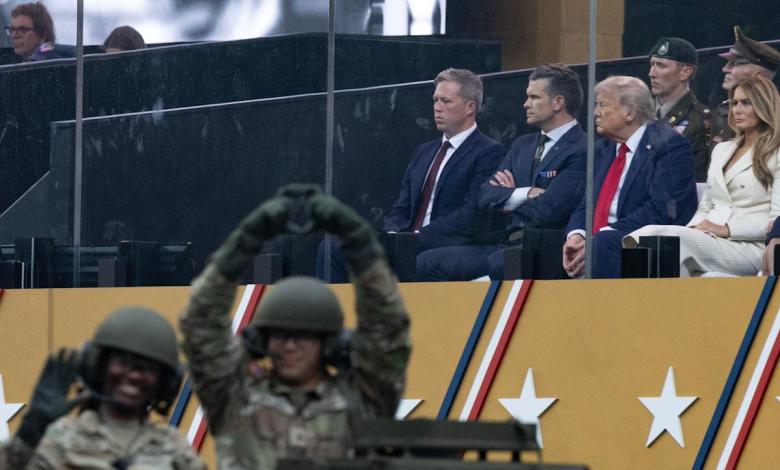
But the soldiers who crossed the Constitution Avenue, the president’s censorship stance, walked loose gaits, disciplined but without robots, and individual soldiers were integrated into the collective without losing their identity. Those riding on tanks, trucks and other combat vehicles waving and smiling, dating with enthusiastic crowds. Announcers usually sound as if they are narrating machines rather than fashion shows in military parades. Bradley Chariot: “It’s fast, it’s tough, and it’s deadly.”
The parade always comes with a message, which is why so many people are on guard. When American painter Childe Hassam painted a series of patriotic events (including the July 4 parade), before the United States entered World War I, he provided an innocent, ruthless sight of red, white and blue that almost all overwhelmed individual parades, as if flags, flags and bunting were enough to win a battle. But during a period of anxiety about mass immigration from European countries, he also proposed a unified image of the United States. The Impressionist fusion of colors mimics the blur of origin in the American furnace.
The last large-scale U.S. military parade in Washington, held in 1991 after the Gulf War, was not only a welcome to the troops, but also a efforts to alleviate the alienation of many Americans from the armed forces after the collapse of Vietnam. The Bastille Day review in Paris has been a more complex matter since at least World War II, a Gaulagian effort to prioritize the orderly vision of the left-wing forces born in revolution and bloodshed in modern France.
In Leni Riefenstahl’s 1935 Nazi propaganda film Triumph of the Will of the Will, a compilation of fearful parades and military glasses – there is a scene where Adolf Hitler passes through the vast open space on the sides of hundreds of troops. They have been reduced to fascist ideals, on a ruthless grid, out of reach of leaders to confirm the huge difference in their identity: one has the agent and all the rest is part of the machine.
Riefenstahl’s image reminds us of the basic rules of thumb for analyzing military parades: look at the edge. Is it the people and the army within it, or has it cut off its own space, cut off the crowd, and lived in its own power and separated from civilian society? The edge of the US military is complex. It is professional, so it is voluntary in addition to the civilian world, and therefore integrates into the structure of American society. Saturday’s heavy safety made it impossible for people to keep people from the troops, but individual service members often seem to intend to bridge the distance with waves and smiles.
This contrasts with the presence of the California National Guard in Los Angeles, where the governor insists that they don’t want or need it, where the edges of their presence are sharp and dangerous and may be cutting. This year not only marks the 250th anniversary of the Army, but also marks the 50th anniversary of the end of the Vietnam War, a historical record of the military’s reputation in the United States. Saturday’s parade could cause great damage to decades of efforts to climb out of that hole.
People oppose the California National Guard in Los Angeles on June 9.
The current president is very good at creating situations to force his critics to have a unique information discipline. So the National Guard on Los Angeles Street was invited to use unprecedented federal use, inviting people to hate unnecessary and expensive people (estimated up to $45 million), but mostly benign Army celebrations in Washington. But the military performed better in terms of information discipline, focusing on its history, services and members.
A warning sign of Army allegiance will be about the harm of how it tells its own story: If it fires its historians, or tries to force its compliance, like other agencies, including the Smithsonians, there will be even more serious trouble. But on Saturday, it keeps history in the forefront, and even the president looks boring for most of the time, it’s no surprise. The Army did this with the country, not with men.