Israel does not obtain a permit to build bomb shelters in these Bedouin villages. So they built it themselves

Bellsheba of Israel (AP) –
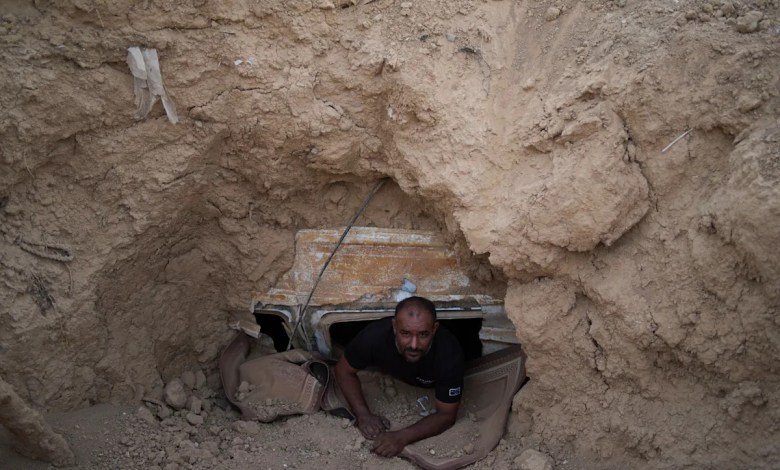
Ahmad Abu Ganima’s family scrambled outside when the sirens in the southern desert of Israel predicted an incoming missile. They squeezed one by one along some muddy steps, through the windows of minibus buried below 10 feet (three meters) of dirt.
Mechanic Abu Ganima took out the abandoned bus from his employer after being stripped of parts. He buried it in the yard to create a temporary bomb shelter for his family. Abu Ganima is part of Israel’s 300,000 Bedouin community, a former nomadic tribe scattered in the arid Negav desert.
Huda Abu Obaid, executive director of the NEGEV Coexistence Forum, said more than two-thirds of the Bedouin people are unable to access shelter, which lobbies the Bedouin problem in southern Israel. The threat of missiles became increasingly severe in the 12-day war with Iran last month, with many Bedouin families resorting to the construction of DIY shelters in available materials: buried steel containers, buried trucks, reused building debris.
“When there is a missile, you can see it comes from Gaza, Iran or Yemen.” Amira Abu Queider, 55, of the Islamic court system, pointed out that he pointed to the village of Squat, which is the wide sky of Squat village. “We don’t have inner gui, but we are injured.”
Lack of public services in the community
Al-Zarnug has not been recognized by the Israeli government and has not received services such as garbage collection, electricity or water. Almost all power sources come from solar panels on the roof, and the community cannot obtain building permits. Residents often receive demolition orders.
In southern Israel, about 90,000 Bedouin people live in 35 unidentified villages. Even those Bedouin people living in Israel’s “approved” areas rarely enter the shelter. Abu Obaid said Rahat is the largest Bedouin city in southern Israel, with eight public shelters that can accommodate 79,000 residents, while Ofakim, near the Jewish town, has 150 public shelters that can accommodate 41,000 residents.
Sometimes more than 50 people try to squeeze into the three square meters of mobile bomb shelters or bury trucks. Others squeezed into cement culverts under train tracks designed to direct storm runoff and hang bed sheets to provide privacy. Residents say the shelter is far away, sometimes forced to leave the elderly and people with travel problems.
According to local leaders, on October 7, 2023, 21 Bedouin people were killed and 6 people were killed, according to local leaders. Abu Obaid said that on the first day of the attack, seven Bedouin people, including children, were killed by missiles in Hamas barrage.
Although no Bedouin was killed or injured in the April 2024 attack on Israel in Iran during its 12-day war, one of the only civilians suffered severe head injuries caused by missile shrapnel.
More than 1,200 people were killed in Israel, and 251 people took hostages during the attack. According to the Gaza Ministry of Health, more than 57,000 Palestinians were killed in Israel’s subsequent war in Gaza, which did not distinguish between civilians and militants.
People want an escape plan
The engineering standards for bomb shelters and protected rooms are detailed and specific, with the types of walls and shock-proof windows that must be used. The Bedouin people who make their own shelter know that they won’t offer much or any protection for direct strikes, but many say it will make them feel good to go somewhere. Abu Ganeima said inside the minibus that the sound of the sirens was faded, which comforted his children.
“Our bomb shelter is not safe,” said Najah Abo Smhan, a medical translator and single mother of Al-Zarnug. Her 9-year-old daughter is frightened and insists that they run to their neighborhood situation, where they repurpose a massive abandoned truck scale because they know it is not enough to protect them from direct blows, even if they know it is not enough to protect them. “We’re just doing a lot of prayers.”
From Israel’s failure to recognize that when the sirens were warned to incoming missiles, “scenes filled with fear and panic were filled with fear and panic.” “The kids screamed, and mothers were more afraid of their children than themselves. They were screaming and thinking about their children, feeling stomachache, fear and crying, ‘Where are we going to die, where will we go?”
Many say that there is no place or hiding feeling almost as terrible as the missile itself.
Some shelters donated, but not enough
After the October 7 attack, Israeli security services placed about 300 mobile bomb shelters in the Bedouin area. Official organizations also donated a few mobile shelters. However, these mobile bomb shelters were not built to withstand Iran’s ballistic missiles and were seriously insufficient to meet a wide range of needs. Abu Obaid estimates that thousands of mobile shelters are needed in the distant Bedouin community.
Home Command, an Israeli military agency responsible for civilian issues, said bomb shelters are the responsibility of local authorities and property owners. No local authorities are responsible for the unknown Bedouin village. Home Command said it is assisting local communities, including the Bedouin, with dozens of temporary bomb shelters in the coming months, despite the community receiving orders for demolition in the past few weeks, rather than shelters, due to the ongoing war.
Arabs in Israel (about 20% of 10 million) are citizens with voting rights, but are often discriminated against. The Bedouin are Israeli citizens, some serving in the military, but they are the poorest members of the country’s Arab minority. Abu Obaid said more than 70% of people live below the poverty line.
Abu Obaid said Bedouin residents did not ask Israel to fund its bomb shelters. They just ask the state to grant them a construction permit so they can build a house with enough shelter. Many people are forced to build illegally due to lack of permissions. However, due to the high construction costs, few people are willing to build reinforced rooms or shelters.
“People don’t even want to try it,” Abu Obayid said. “It’s very expensive and then two weeks later, the state comes and says you have to destroy it.”