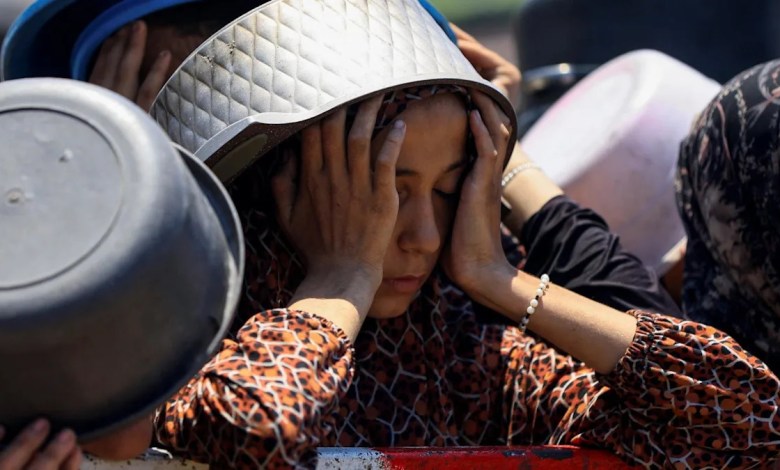
More than 100 international aid and human rights groups have warned the public of Gaza that are hungry and urged the government to take action.
Médecins, Save Children and Oxfam of Sanans Frontières (MSF) are among the signatories of the joint statement that says their colleagues and the people they serve are “wasteing”.
Israel, which controls all materials to enter Gaza, denies that it is the cause of growing food shortages.
The organization’s warning comes as Hamas-and Health Ministry in the region said that malnutrition in the last 24 hours has resulted in the deaths of 10 other Palestinians.
According to the ministry, this brought the death toll since Gaza to 43 years old.
The UN report said the hospital has acknowledged people with severe exhaustion due to lack of food, and others are said to have collapsed on the street.
“As the Israeli government’s siege has starved the people of Gaza, aid workers are now joining the same food line, risking shootings are just to support their families,” said 109 humanitarian groups in a statement issued on Wednesday.
“With the supply now completely exhausted, humanitarian organizations are witnessing their colleagues and partners are wasting their eyes.”
Israel imposed a full blockade on Gaza in early March and resumed its military offensive against Hamas two weeks later, shutting down a two-month ceasefire. It said it wanted to put pressure on armed groups to release its remaining Israeli hostages.
Although the lockdown partially eased nearly two months later, shortages of food, medicine and fuel worsened amid the looming famine of experts around the world.
Human organizations warn: “Doctors have reported rates of acute malnutrition, especially in children and the elderly. Diseases such as acute watery diarrhea are spreading, markets are empty, waste is piled up, and adults are collapsing due to hunger and dehydration,” the humanitarian group warned.
“Aiders who provide psychosocial support talk about the destructive effects on children: ‘Children tell parents that they want to go to heaven because at least there is food in heaven.’’
The World Health Organization said nearly 100,000 women and children suffer from severe acute malnutrition and need to be treated as soon as possible.
Dr Ahmad al-Farra, head of pediatric hospital at the southern city of Khan Younis, told the BBC that no food is available for three days.
He said the children came to his unit and experienced varying degrees of hunger.
He added that some people are malnourished and die in the care of the hospital. Others have separate health problems that prevent nutrients from being absorbed by their bodies.
“We’re worried we’ll get to this point – now we have it,” he said.
Humanitarian organizations also noted that the United Nations has documented the killings of the Israeli military, which has been attempted by more than 1,050 Palestinians since May 27, a controversial aid distribution mechanism carried out by the Israeli and the United States-backed Gaza Humanist Foundation (GHF) in an alternative to non-expert agencies.
According to the UN Human Rights Office, 766 people have been killed near four aid sites in the GHF, located in the Israeli military zone and run by a U.S. private security contractor. Near the United Nations and other aid convoys, another 288 people were killed.
The Israeli military said its troops deployed near the GHF site only issued warnings that they did not intentionally shoot civilians, while the GHF said the United Nations is using “false and misleading” figures from the Gaza Ministry of Health.
Humanitarian groups also said that almost all of Gaza’s population was displaced, now limited to 12% of the uncovered territory of Israel’s evacuation order or within Israel’s militarized areas, making aid operations unsustainable.
They said that on average, only 28 truck aid is allocated in Gaza every day.
“Just outside the warehouses outside Gaza, even within Gaza itself – a large amount of food, clean water, medical supplies, shelters and fuel have not been blocked or delivered to them by humanitarian organizations.”
Nearly 100,000 women and children are severely acute malnutrition in Gaza, UN says [Reuters]
The United Nations said Israel, as the right to occupy, has an obligation under international law to ensure that humanitarian assistance can reach all the populations needed.
Israel insists on acting in accordance with international law and promotes access to aid while ensuring it does not reach Hamas.
It recently acknowledged a sharp drop in supply to Palestinians but blamed the United Nations agencies.
Coordinating with the Israeli military regiment to enter Gaza in the past two months, nearly 4,500 truck loads have entered Gaza, including 2,500 tons of baby food and children’s high-calorie specialty food.
It also published drone videos showing what it says is aid for 950 vans, awaiting collection by the United Nations and other international organizations on the Gazan side of Kerem Shalom and Zikim Crossings.
“The bottleneck in this collection remains a major obstacle to maintaining humanitarian aid into the Gaza Strip,” Kogat said.
The United Nations has repeatedly stated its efforts to obtain the necessary Israeli authorization to collect new supplies from within the intersection with Gaza drivers and transport them through military areas.
Continued hostilities, severely damaged roads and severe fuel shortages have exacerbated the problem. The crime of plundering by armed gangs sometimes ceases to take action.
The United Nations has said a major problem in recent weeks is efforts to obtain a commitment from the Israeli military that desperate Palestinians will not be killed when trying to collect aid from the convoy.
“In too many cases, Israel allows UN teams to collect supplies from a closed yard near the Gaza border crossing, despite repeated assurances that the troops are not involved or present,” UN spokesman Stéphane Dujarric told a briefing Tuesday.
“This is not enough to emphasize that this unacceptable pattern is the opposite of the appearance of promoting humanitarian action. There is absolutely no one who should risk his life to get food.”
Humanitarian groups say they “can’t continue to hope that the current arrangements will work” and it’s time for the government to “take decisive action”.
“Request for an immediate ceasefire; remove all bureaucratic and administrative restrictions; open all land crossings; ensure contact with all people in Gaza; reject distribution models of military control; restore principled, non-leaderly humanitarian responses and continue to fund principled and impartial humanitarian organizations.”
They added: “States must take concrete measures to end sieges, such as stopping the transfer of weapons and ammunition.”
On Monday, the British Foreign Secretary and 27 other countries called for an immediate end to the Gaza war. Israel’s foreign ministry said the statement “disconnected from reality and conveyed the wrong message to Hamas.”
The Israeli military launched a campaign in Gaza on October 7, 2023, in which about 1,200 people were killed and another 251 were taken hostage.
At least 59,106 people have been killed in Gaza since then, according to the Hamas-Operation Ministry of Operations.