One person stopped climbing the U.S.-Mexico border wall. U.S. military issues alarms according to new Trump rules

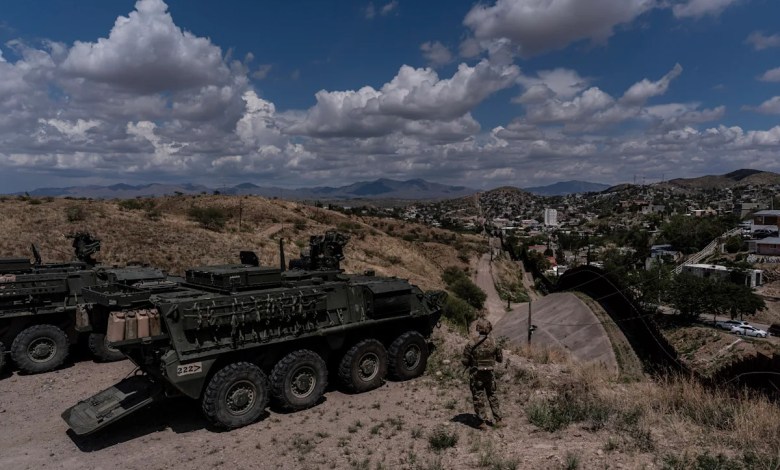
Nogales, Arizona (AP) – Inside an armored vehicle, the Army Scouts use joysticks to point the long-range optical range to a man perched on the U.S.-Mexico border wall, across the hills of the Arizona border community.
The man lowered himself towards the soil between the hexagonal coils. Shouting, alarming, and competing towards the walls of the U.S. Border Patrol SUV racing – the warning was enough to get the man to climb back onto the wall and disappear into Mexico.
Witnesses on Tuesday were one of only two people patrolled the Army’s infantry department on the southern border, where President Donald Trump’s urgent announcement would put the military in a central role in preventing the U.S. from crossing through immigrants between U.S. ports.
“The deterrence is actually boring,” said the 24-year-old Army Sergeant. Ana Harker-Molina, who expressed the boredom of some soldiers in sporadic sightings.
Still, she said she was proud of the work because they knew the troops were blocking the crossings just by themselves.
“As long as we sit here and look at the border, it is helping our country.” He is an immigrant, who himself came from Panama at the age of 12 and became a U.S. citizen while serving in the military two years ago.
U.S. troops deployed at the border have tripled to 7,600 people and include every branch of the military — even as the number of attempted illegal crossings has dropped, while Trump has authorized funding for another 3,000 Border Patrol agents, providing $10,000 signing and retention rewards.
The military mission is carried out from a new command center along with the Wachuka Mountains in southern Arizona. There, the community hall has been transformed into a bustling war room for battalion commanders and staff, with digital maps pointing to military camps and movements along the border of nearly 2,000 miles.
So far, border law enforcement has been the area of civilian law enforcement, and the military has only intermittently intervened. But in April, a large swathe of borders was designated as a militarized zone, authorizing the U.S. military to arrest immigrants and others accused of getting involved in the military, air force or navigation base, and authorizing other crime costs.
The two-star general who led the mission said the troops were not bound by maintenance and warehouse missions to work closely with U.S. Border Patrol personnel in high-traffic areas to conduct illegal crossings and quickly deploy to remote, unattended terrain.
“We don’t have a (labor) union, how many hours we can work in a day, how many transformations we can make,” said Army Major Scott Naumann.
“I can drive the soldiers out when I need it to solve the problem, we can put them in a few days at a time, we can bring people into incredibly remote areas because we see the cartels change”.
A patrol that aims to stop the “stumped”
In Nogales, the Army Scouts patrol the border in full combat equipment (helmets, M5 service rifles, bulletproof vests) and have the right to use lethal force if attacked in conventional military rules incorporated into border missions. Smugglers at feet have routinely tried to drive tunnel tunnel tunnel tunnel tunnel tunnel tunnel tunnel tunnel tunnel tunnel tunnel into contraband into the United States
Naumann’s command post oversees 117 armored Stryker vehicles, more than 35 helicopters and six long-range drones that can survey the border with sensors day and night to determine people wandering in the desert. Marine Corps engineers are adding hexagonal wire as the Trump administration restarts the construction of the border wall.
The point is to stop being “in a dilemma”, Naurman said, who escaped the authorities’ disappearance in the U.S. in a match against the clock, which could last for a few seconds in urban areas as people vanished smuggling vehicles, or in dense wetland bushes in Rio Grande or in dense wetland bushes in Arizona’s vast desert and mountain wilderness.
Meanwhile, the border’s worry rate fell to a 60-year low.
Nauman said the decline in illegal entries was “elephant in the room” as the military added pressure and resources to starve the cartels to death, including Latin American gangs recently designated as foreign terrorist groups.
He said it was wrong to let go, and as the summer heat ended, the crossing could rebound.
He said of the mission without a fixed date: “We have to keep moving forward, we have some success, and our trend is positive.”
The militarized area is a “gray area”
The Trump administration is widely utilizing the military to promote its immigration operations, from guarding federal buildings in Los Angeles from protests against ice detention, to assisting Florida’s immigration and customs enforcement to planning to detain detained immigrants in military bases in New Jersey, Indiana and Texas.
“It’s part of a very muscular, strong, intimidating, radical response to the same strategy to show his foundation’s commitment to the campaign is serious,” said Dan Maurer, a law professor at Northern Ohio University.
“It’s both normative and unusual. It puts the army in a very awkward position.”
At the border, the military area avoided the Persian West Trojan Act, a law of 1878 that prohibited the military from enforcing the law on American soil.
“In that gray area, this could be illegal – probably not. The military always has the right to arrest people and detain them at military bases,” said Joshua Kastenberg, a professor and former Air Force judge at the University of New Mexico Law School.
Security adviser Michael Fisher was the former head of the Border Patrol from 2010 to 2016, and the border military expansion became a “troop multiplier” as the Border Patrol grew farther and farther away from the border.
“The military allowed the Border Patrol to bend into other areas that were not normally possible,” he said.
This strategy presents inherent moral challenges and political risks.
In 1997, an 18-year-old U.S. citizen was shot dead while being grazed by Marines on a border anti-drug patrol in a remote Great Bend in western Texas. Authorities say Esequiel Hernandez has no connection with the drug deal and is an honors student.
The shootings pissed anger along the border and prompted military deployment of then-President Bill Clinton to the border.
In New Mexico, the latest restrictions unless access to military areas has become a popular area for hunting, hiking and off-road racing, thus avoiding recreational activities, which has sparked strong protests from some residents.
Adults can apply for access online and agree to a criminal background check, Nauman said, which he called a standard requirement for access to a military base.
He said: “We are not trying to stop Americans from recreating in the United States.
Military-grade equipment
At dawn Wednesday, the Border Patrol car climbed the slopes of Mount Christo Rey, an iconic peak with a crucifix that pierced the sky above the city suburbs of El Paso and Mexico and Mexico’s Cudade Juarez, without other souls.
The summit is located at the confluence of two new militarized areas designated as the Army Station in Brisburg, Texas and the extension of Fort Wachuka, Arizona. The Department of Defense added a 250-mile (400km) area in the Rio Grande Valley, Texas, connected to the air force base.
The Navy will oversee the border near Yuma, Arizona, where the Interior Department ceded part of the 32 miles (50 kilometers) of the border to the army on Wednesday.
At Mt. Cristo Rey, the Department of Homeland Security has released plans to close the border walls of a 1.3 miles (2 km) gap in border walls, while the Roman Catholic diocese owns most of the land and says a wall would hinder religious pilgrimage to the sacred shelter.
From the nearby Mesa summit, Army SPC. Luisangel Nito used infrared range to scan the valley below Cristo Rey, which highlighted the heat of the body, and found three people illegally crossing the United States for Border Patrol to arrest the Border Patrol. The NITO’s unit also has small drones that can be grounded to map the access route.
Nito is the American-born Mexican immigrant son who entered the country in the 1990s through the same valley he now patrolled.
“They cross here,” he said. “They told me to be careful because when they cross, they said it was dangerous.”
During the financial crisis, Nito’s parents returned to Mexico in 2008, but soldiers saw a brighter opportunity in the United States to return and enlist. He has no reservations about his role in detaining illegal immigrants.
“Obviously, it’s a job, right, and then I signed up, I’m going to do that,” he said.
On Cristo Rey Hill and elsewhere, the troops used the obvious border patrol vehicles as Naumann’s champion, advocating the “fusion” of civilian law enforcement and military power.
“If there is a secret seasoning, it will be integrated in every echelon if you can,” Neumann said.