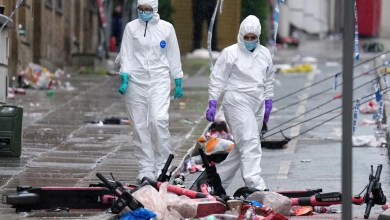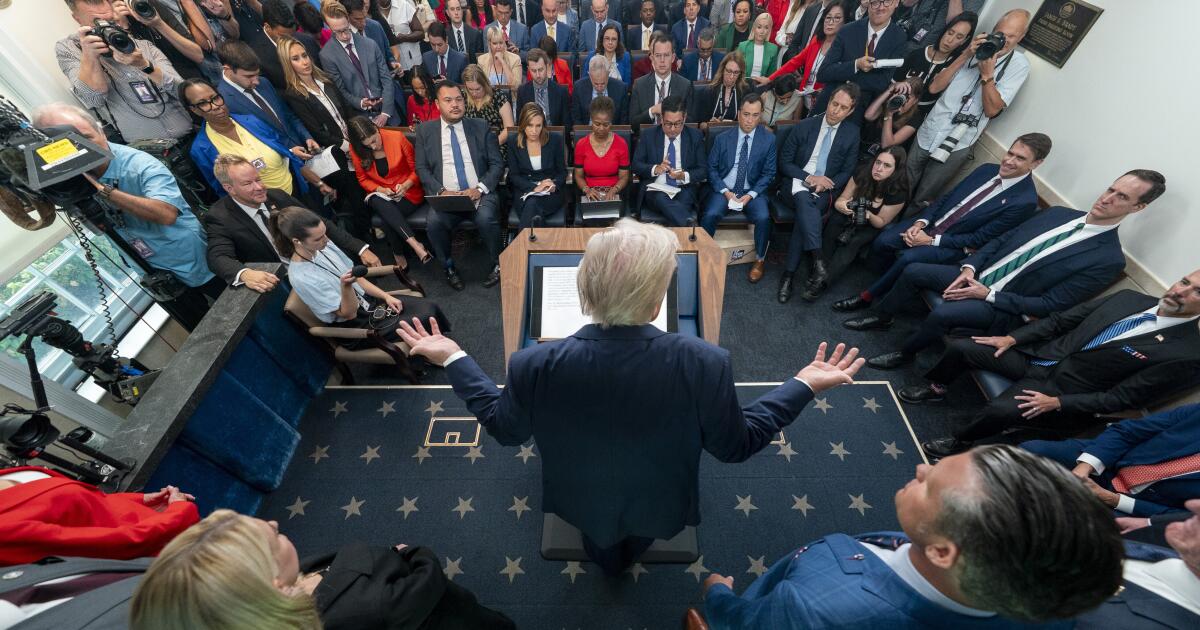
A few minutes after the second quarter. At the Department of Defense, Pete Hegseth touted plans to “flood” Washington with the National Guard, where a U.S. military official came to power in a federal court in California to defend the controversial soldiers’ deployment to Los Angeles.
Since then, the protests earlier this summer have become a role model for President Trump to increasingly use soldiers to the streets of the United States.
But the trial opened in San Francisco on Monday to open a debate in California that Trump’s troops illegally engage in civilian law enforcement.
“Southern California’s military is so related to ice and other law enforcement agencies that they are indefinitely indistinguishable,” California agent Atty. General Meghan Strong told the court on Tuesday.
“Los Angeles is just the beginning,” the lawyer continued. “President Trump has suggested sending troops further away and naming Baltimore and even Oakland in the Bay Area as his next potential target.”
Senior U.S. District Judge Charles R. Breyer said in court that Hegseth’s statement on Monday could be favorable to the state, which must show that the law could be violated again as long as the troops stayed.
But the White House has not allowed the pending cases to stagnate. The judge’s order also failed to gradually judge Trump officials, which restricted the so-called “patrols” used by federal agents to abuse suspicious immigrants.
After a peripheral Border Patrol agent broke out from a truck moving in Penske and snatched workers (which appeared to be publicly violating court orders) at Westlake Home Depot, some lawyers warned that the rule of law was invisible.
“It’s really breathtaking,” said Mark Rosenbaum, public legal counsel, a part of the alliance questioning the use of racial profiles by immigration enforcement. “Somewhere, there was a founding father who moved in the grave.”
The arrests of chaotic immigrants sweeping Los Angeles this summer have barely stopped after the original July 11 order, which prohibits agents from robbing people without first establishing reasonable suspicions that they are illegal in the United States.
The ruling on August 1 in the 9th Circuit seems to ensure that they cannot recover again for weeks, if any.
For the strike Justice Department, the 9th Circuit’s losses are the latest blow in the long-term judicial assault, as many of the government’s most radical moves have been blocked by federal judges and kidnapped in the Court of Appeal.
“[Trump] “There have been nearly nine consecutive losses in the lower courts,” said Eric J. Segall, a professor at Georgia State University School of Law.
In the past two weeks alone, the 9th Circuit also found that Trump’s executive order ended the unconstitutional unconstitutionality of birthright citizenship and said it could rule that it favors a group of researchers at the University of California who hope to withdraw funds from Trump’s so-called DEI policy.
Elsewhere in the U.S., the DC Circuit Court appears ready to stop Trump’s tariffs, while a federal judge in Miami temporarily stopped the construction of the crocodile Taras.
California. General Rob Bonta said in shock that his Justice Department has prosecuted the government nearly 40 times.
But even the current litigation’s breakthrough pace is glacier compared to the actions of immigrant agents and federal forces.
Federal officials have publicly appreciated Bigfoot News and Los Angeles Mayor Karen Bass, who have repeatedly warned the city to be used as a “peptide dish” for the executive force.
On Monday, the White House seemed to prove them by sending the National Guard to Washington.
President Trump spoke for more than half an hour in half, disrupting the list of American cities he besieged.
When asked if he deployed troops to these cities, the president said: “We’re just looking at what happens.”
“We’re going to look at New York. We’re going to do the same thing in Chicago if we need it,” he said. “Hope Los Angeles is going to look at it.”
This image taken from the video shows that on August 6, 2025, we jumped out of the Border Patrol from Penske box truck while immigrants raided a home depot in Los Angeles.
(Fox News/Matt Finn via AP)
The Justice Department believes that the same power to allow presidential federal forces and deploy them on U.S. streets constitutes a Constitutional Exception, a 19th-century law that prohibits soldiers from taking civilian police action.
California lawyers say there is no such exception.
“I’m thinking about this situation, trying to figure it out, there any Restricted use of federal forces? ” Judge Breyer said.
Ilya Somin, a law professor at George Mason University and a constitutional scholar at the Cato Institute, said Trump administration officials “haven’t lost much” even if they have been suffering.
“Base loves it,” Thorin said of Trump’s most controversial move. “If they lose, they can consider whether they violate the court.”
Other experts agree.
“The bigger question is whether the courts can actually take any action to execute their orders,” said David J. Bier of Cato College. “There is no sign that I [Department of Homeland Security agents] Changing their behavior. ”
Some scholars speculate that the blood of the lower courts may actually be a strategic sacrifice to extend the power of the Supreme Court president in the war.
“This is not the main ambition to win,” said Professor Mark Graber of Francis Kim Carey School of Law in Maryland. “They are taking the case around the district court, but always ordering the district court orders.”
Segall, a law professor who studies the Supreme Court, believes that winning or losing in a lower court is effective against California’s political charm.
“People on the West Coast don’t understand the emotional hostility of California,” Segar said. “California…is almost seen as a separate country.”
He and others warn that a favorable Supreme Court ruling could pave the way for deployment across the country.
“We don’t want the military to be on the streets of the United States, it’s all-weather parking,” Segar said. “I don’t think martial law is on the table.”
Pedro Vásquez Perderdomo, a worker who is one of the plaintiffs in the Southern California case, challenged the racial profile of immigration enforcement, and he said the case is bigger than him.
He was on the podium outside the downtown office of the American Civil Liberties Union on August 4, and his voice trembled as he spoke of the interim restraining order, an interim restraining order before the 9th Circuit Court of Appeals – a circuit between his fellow countryman Angelenos and unappointed federal authorities.
“I don’t want silence to be my story,” the worker said. “I want to be justified for me and for the rest of other human beings.”