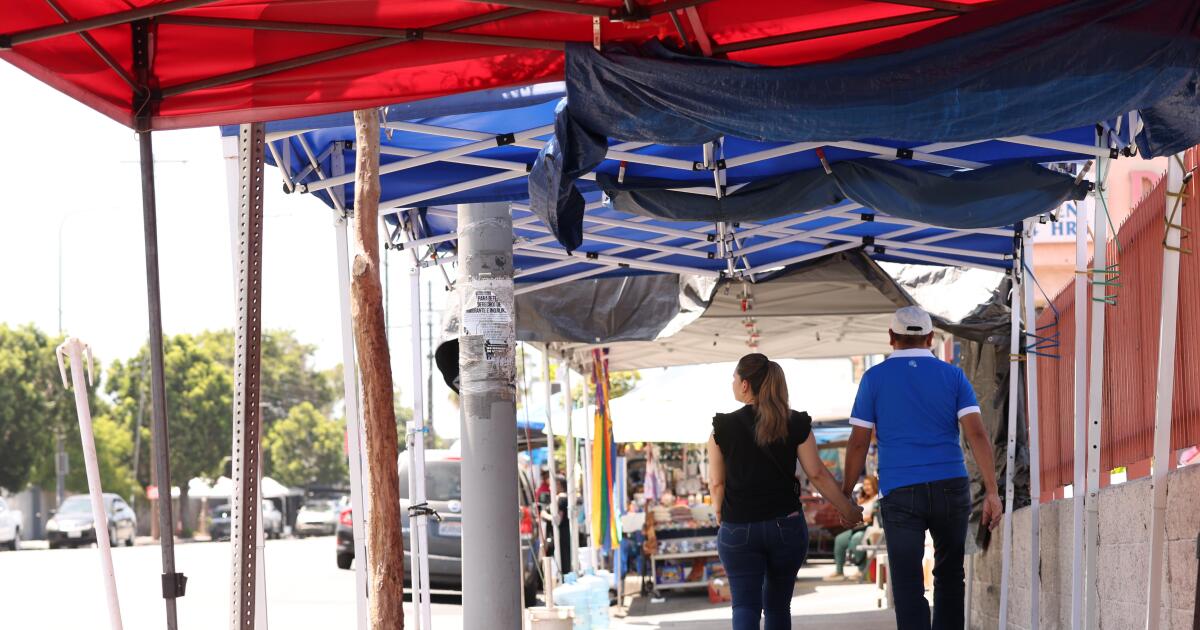
Streets and parking lots, lawn mowers on the front lawn and ice cream trucks abandoned on the sidewalks are left in the streets and parking lots, cars left on the lawn mowers.
In the midst of aggressive immigration sweeping by the Trump administration, more and more desert goods stocks are spread across Southern California. In each case, the property was left behind by the persons warned by federal agents. car. Vending machine. Work tools. Food Truck. When authorities arrested two gardeners outside their Ontario residence, the homeowner went outside to see lawn mowers still running, lawn half mows and worker trucks on the driveway.
As the raid enters their second month, an increasing effort is that even after someone is arrested, their property will be returned to their families.
A local police department announced it would attempt to return abandoned property, such as vehicles and work equipment, to relatives detained by U.S. immigration and customs law enforcement officers.
“We are using it out of the box to see how we can help these families,” said Natalie Garcia, a public information officer for the department.
Grassroots efforts in the region are also increasing to let families know about arrest.
Abandoned property has been a common problem for families, who were separated by immigration raids that began in early June. Under normal circumstances, if someone is arrested while driving a vehicle, it may be confiscated and removed from office by the arresting agency.
But, in the recent immigration attacks, people were abandoned in public after being detained by masked federal agents, who are often seen in videos that hurriedly left the area and abandoned property.
Santa Ana police said they are looking for ways to identify the owner and return the property before somehow losing it, creating further burdens for families affected by deportation.
Since the raids began, some advocacy groups have mobilized to remind community members of when and where immigration raids occurred and to link affected families with legal and financial support.
For weeks, some of these groups were actually middlemen, returning some of their property to the family. The groups have published and distributed videos and images of the raids in hopes of identifying detained people, informing families, and letting them know when no one is taking care of their property.
Returning one’s own property to a secondary priority may be a sudden view of the family of a loved one being detained by immigration officials. But advocates point out that, for example, certain properties (e.g., vehicles) are crucial to the daily life of the family, especially after relatives are deported.
Sandra de Anda, co-founder and director of policy and legal strategy at OC Quick Response Network, a group of organizations that provide resources for families affected by the Orange County raids – said the group often encounters carts and vehicles left behind by car owners after ICE detention.
“What we see is that they are everywhere,” she said.
Sometimes some of the properties are abandoned by street vendors who choose to leave instead of risk detention after hearing about immigration officials in the area.
“They sometimes leave the device for hours,” she said.
In other cases, cars are unattended in the parking lot near the court where people are detained.
Deanda said so far, members of the community have worked together to determine who the car belongs to and contact family members to retrieve them before being towed.
Sometimes, when families recognize vehicles on social media, they realize that relatives are being detained by Ice.
“A lot of times, these families are usually the ones who pick up cars,” she said.
Garcia said Santa Ana police also hope to help families in this way.
On June 26, the department posted a message on social media that it would “make reasonable efforts” to contact family members and return to property.
Garcia said the department had already begun working to return some property about a week before the message was sent. Garcia said she has no information on how many families she has contacted so far.
She said the information was placed on social media to help connect with residents who may have contacted police due to immigration assaults.
“I’m sad that many community members don’t want to call us because they still associate us with federal agents,” Garcia said. “But you can call [Santa Ana police] And, if you don’t have a paper, we don’t care. We are here to help you. ”
Advocates say this distrust may be a matter of law enforcement.
De Anda said that when an immigration raid occurred in Orange County, the OC Quick Response Network may receive a minute call from residents reporting activities or asking about services.
Many of them are more likely to be in contact with groups like the Internet than local police, she said.
Garcia said Santa Ana’s efforts were also a way for the department to remind residents that local police did not work with federal agents to engage in immigration enforcement.
“We want to remind our community that we are here to serve and protect them,” Garcia said. “We do not take any federal immigration action.”
Tamara Marquez, spokesman for the Inland Immigration Justice Alliance, agreed. Her organization has been monitoring and reminding the ice-hitting communities in Riverside and San Bernardino County, and contacts about abandoning cars and trolleys.
In many cases, even the citizens of people detained by ice avoided law enforcement with the property because they fear other family members might be targeted.
“They really don’t want to come out and say it’s my family because the family has different identities,” she said.
Instead, community members sometimes step in to contact the owner and protect the property, she said.
She said four people inside the van were detained in an incident in Eastville, and the vehicle was left in the middle of the street with keys inside.
Nearby residents pushed the van into the driveway of the house until relatives of the detainees identified the van on social media, Max said.
“We’re seeing an increase in lost vehicles because [of] “A lot of times people find their families arrested because the vehicle is left behind and therefore arrested and detained.
In June, Ontario resident Chris Ames went out to find his gardener arrested. He told KTLA News that lawn mowers were still running and authorities left workers’ cell phones and keys in the unsecured interior of the truck. A few hours later, a family member arrived at the truck.
“I think this is wrong. It’s not the way we treat people,” he told the station.
Garcia said officials hope residents can seek help from police regardless of their immigration status.
Those who find abandoned property are asked to contact the department’s communications office at (714) 245-8665.