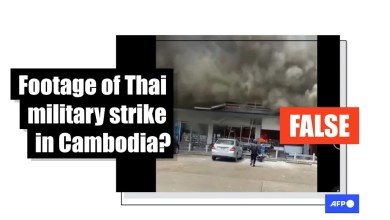
Thailand and Cambodian leaders meet in Malaysia to negotiate to end deadly border disputes – State


Thai and Cambodian leaders will meet in Malaysia for talks with hostilities, a spokesperson for the Thai Prime Minister’s Office said on Sunday. It is now on the fourth day after U.S. President Donald Trump ended pressure on a deadly border dispute, at least 34 people were killed and more than 168,000 were displaced.
Jirayu Huangsap said Acting Prime Minister Phumtham Wechayachai will attend Monday’s talks in response to the invitation of Malaysian Prime Minister Anwar Ibrahim to “discuss peace efforts in the region.”
The spokesman also said that the fake Cambodian rival will also participate in the talks, although Cambodia did not immediately confirm. He added that Anwar, as president of the Association of East Asian Nations or the Association of ASEAS, is held annually by its 10 members.
Trump posted on “Social Truth” on Saturday that he spoke with leaders in Thailand and Cambodia and suggested that he would not move forward in the hostilities continuing to trade agreements with either country. He later said that both sides agreed to hold a meeting to negotiate a ceasefire.
Both sides agree to discuss a ceasefire
Cambodian Prime Minister Huns said earlier Sunday that his country agreed to pursue a “direct and unconditional ceasefire.” He said Trump told him that Thailand also agreed to stop the attacks after a conversation between the U.S. president and Fimsom.
He said he appointed his deputy deputy secretary Prak Sokhonn to coordinate the next step with U.S. Secretary of State Marco Rubio and interact directly with Thailand’s foreign minister to implement the ceasefire.
Thailand expressed cautious support. Thailand’s Foreign Ministry said that Feimutm thanked Trump and said that Thailand agreed to the ceasefire in principle, but emphasized the need for Cambodia’s “sincere intentions.” It called for rapid bilateral negotiations to discuss specific steps towards a peaceful solution.

Get the daily national news
Get news, politics, economics and current events titles delivered to your inbox every day.
Both sides accuse each other of conflict
The battle broke out on Thursday after a blast wounded five Thai soldiers along the border. The two sides blame each other and began to clash. The two countries recalled the ambassadors that Thailand closed its border crossing with Cambodia.
Despite diplomatic efforts, the fight on Sunday continued along parts of the disputed border, with both sides refusing to blame and blame for the re-bombardment and the movement of troops.
Colonel Richa Suksowanant, deputy spokesman for the Thai Army, said Cambodian troops fired heavy artillery at the Surin province earlier on Sunday, including civilian houses. Cambodia also launched rocket attacks against the ancient Ta Muen Thom Temple, both countries claiming other areas of Thai forces to protect their territory, he said. Thai troops responded with long-range cannons to attack Cambodian cannons and rocket launchers.
Ritchie said Trump’s efforts to mediation were “an independent thing.” He added that battlefield operations will continue and a ceasefire will only occur if the negotiations are formally initiated in Cambodia.
The Thai Foreign Ministry said separately: “In the case of serious lack of sincerity in Cambodia, any cessation of hostilities cannot be achieved and repeatedly violates the basic principles of human rights and humanitarian law.”
Cambodian Defense Ministry spokesman Lieutenant General Maly Socheata accused Thai troops of bombing violence earlier on Sunday, followed by tank and ground forces in multiple areas, another “massive invasion”.


“This action undermines all efforts for a peaceful solution and reveals Thailand’s clear intention to escalate rather than reduce conflict,” she said.
Thailand reported a new death toll on Sunday, bringing the total death toll to 21, most of which are civilians. Cambodia said 13 people were killed. More than 131,000 people have evacuated to safe locations in Thailand, and more than 37,000 people have fled from three Cambodian provinces. Many border villages are mostly empty, and many schools and hospitals are closed.
Evacuation Hope Hope to quickly end the battle
Pichayut Surasit, an air conditioning technician in Thailand, said the sudden outbreak of the fight meant leaving his job in Bangkok to return home to protect his family.
“I didn’t have the heart to continue working when I heard the news. I wanted to come back as soon as possible, but I had to wait till night.” Now, in a shelter in Sulin, Pichayut is worried about his wife and twin daughters, hoping that the conflict will end soon so that they can return to their home in Kap Choeng, one of the most bombarded people.
Local supplier Bualee Chanduang moved to the same shelter with his family and pet rabbit on Thursday, counting on swift negotiations to end the violence. “I pray to God for help so that both sides can agree to talk and end the war,” she said.
Pope Leo said in the Vatican that he is praying for everyone affected by the world war, including “those affected by the conflict between Thailand and Cambodia, especially children and displaced families.”
The UN Security Council calls on ASEAN to be a regional group to mediate peace between two members. Human Rights Watch condemned the reported use of cluster ammunition, weapons prohibited in densely populated areas, and urged both governments to protect civilians.
The 800-km (500-mile) border between Thailand and Cambodia has been controversial for decades, but past confrontations have been limited and short-lived. The latest tension broke out in May when Cambodian soldiers died in a confrontation that created diplomatic rifts and rumbling on Thailand’s domestic politics.
& Copy 2025 Canadian Press