Beyond Gates’ prediction: Nicole aims at Doug’s shocking death wish


Beyond the door The prediction version is here! We will talk about Nicole Dupree Richardson (Daphnee Duplaix), targeting Dani Dupree (Karla Mosley) and Dr. Doug McBride (Jason Graham), with a desire to die. There are predictions about Eva Thomas (Ambyr Michelle), Dr. Ted Richardson (Maurice Johnson) and Nicole, Doug and Joey Armstrong, Nicole and Danny, Nicole and Danny, Nicole, Andre Richardson (Sean Freeman) and Ashley Morgan (Jen Jacob), and Dana “Leslie” Thomas (Trisha) (Trisha’trisha’trisha’trisha grant. As always, our predictions are based on official spoilers and we are just discussing where these exciting storylines are going.
Eva’s docking plan: Will she reunite Ted and Nicole outside the door?
So our first prediction is that EVA will play matchmaker and reunite Ted and Nicole. So on Monday we have an Eva destroyer who has gained the power and support of unlikely people. I just wonder if it could be Nicole. Eva ran to the office in the hospital on Thursday for her first day of work for her dad, Ted. So we all know that Eva feels very indulgent to destroy Ted and Nicole’s marriage. Eva’s psychic mom, Leslie, was almost once her toxic gas since her father Ted didn’t want her and Nicole to be a reason he didn’t have in his life.
Of course, this is just all the crazy Leslie novels. So now Eva is trying to take responsibility for her mistakes. Ted hugged her because he felt sad for missing out on Eva’s life. She also tried to make changes by helping Lara return to work in Nicole’s home office. Eva kept showing her things whenever Laura was in trouble. However, Nicole is very clear about Eva and she’s better not to think that helping Laura means she can be next to the house. Eva accepted all the anger she deserved. But we also know from Nicole’s conversation with others that she is mostly weird, not her daughter.
So, as Eva works for Ted in the hospital, Nicole will often see her stepdaughter. The main problem Nicole has with Eva is that Leslie is the monster that continues throughout her life. So if Leslie’s terrible mom leaves town or Eva takes her out of life, that might soften Nicole. Even if she never accepted Eva, I do think Ted’s daughter will try to help him win Nicole because Eva feels ruining his life and marriage.
Aside from the door: Nicole’s anger – Will Danny’s abortion accusations spark sisterly disputes?
The second prediction is that Nicole is upset about Dai’s abortion allegations. So, on Monday, Bill Hamilton (Timon Kyle Durrett) and Vernon Dupree (Clifton Davis) face to face. It could be about Martin Richardson (Brandon Claybon) chaos. After this stroke, Bill couldn’t handle the pressure, and his return to the chaos might really worry Haley Lawson (Marquita Goings).
On Tuesday, Dani had deep thoughts with Bill and has been involved since she had a stroke. Then next week at the promotion, Dani is with Ashley. So next week we have a pregnant Hayley suffering from severe abdominal pain. This is confirmed. You know, standard pregnancy can be just pain and pain, even pain. It may be a pregnancy complication. This could be a real high-level situation because Bill’s stroke stress or just worrying about him being too much for Haley. I’m going to say that if she’s on Bill for a long time, she’s very convincing. I just don’t think she is.
So, during the promotion, we held Dani at the hospital with nurse Ashley. Danny says Hayley is faked for her pregnancy, is faked for miscarriage, and wants to blame it on Danny for losing her fake baby. The conversation is happening in the hospital. So, I wonder if Nicole heard it. Remember, Dani is already sleeping with Andre on Nicole’s stool list.
Nicole may be very sensitive to the subject of miscarriage. Because if you remember, Ted cheated with Leslie when Nicole kept getting pregnant through Katherine “Kat Richardson” (Colby Muhammad). So I just think Nicole hears Dani refute another woman’s miscarriage as a plan, especially if Nicole peaks on Hayley’s record and thinks it’s a real deal, she will react. This may actually separate the sisters. It’s linked to my next prediction.
Beyond the Door: Romantic Slayer – Will Nicole push Andre to Ashley?
So, the third prediction, Nicole pushes Andre toward Ashley. According to official spoilers, Nicole entered Andre on Wednesday. Thursday’s spoilers said Ashley and Andre discussed the choice. So, last week, Nicole faces anger when Dani discovered that her sister was sleeping with her. But Dany insisted that the bloodless tie between her and Andre didn’t help much, because she knew him since childhood.
So you may remember Nicole also knows Andre’s obsession with Ashley. Now, Nicole has previously advised Andre not to chase her because Ashley happily dates Derek Baldwin (Ben Gavin), but now Nicole is hooked up by Andre to her sister.
That’s why she chewed him this week. Nicole may notice Andre and Ashley’s heads at the hospital this week. Plus, everyone in the hospital knows each other’s business, which means Nicole knows Ashley was abandoned by Derek. So I just wonder if Nicole Will Will breaks Dani’s romance with Andre to a woman he wants for a long time Ashley.
Nicole might think Dani will overcome it, and for Dupree’s family, it’s a less-explicable choice than Andre’s bragging surrogate aunt. Dupree does not need other adverse stress. Dani and Andre will be very sketchy media in full disclosure.
Leslie’s desperate plea: Will she be fled from the town to escape arrest?
Our fourth forecast Leslie proposes to leave town to avoid arrest. So Monday’s spoilers Leslie approached Jacob Hawthorne (Jibre Hordges) and Kat, and she had the idea. She desperately hopes to leave the prison. Apparently on Friday, Leslie tried to treat things with Eva, and these were confirmed spoilers. So we know Kat took Leslie’s DNA off the napkin with some help from Mona. Now, Kat and Jacob are just waiting to regain the test results to prove that Leslie’s DNA is in a video of Laura’s motorcycle rider, seen in a video of the scene of the accident where Laura is not.
As crazy as Leslie, she is not a fool. She knew the wall was closing. That’s why I suspect she went to Kate and Jacob. Maybe Leslie will try to bargain with them to avoid being arrested for Lara leaving the road. Leslie may quietly leave town and don’t bother Ted and Nicole if they give up on investigation. I mean, honestly, I don’t trust Leslie, but at the same time, I don’t want to see her go because she’s a funny little villain. However, we will see that because it looks like Jacob and Kate have Leslie on the ropes, she will be arrested soon. However, Nicole does think that another woman of Ted will get rid of the charges of facing crime and almost kill Laura Beyond the door.
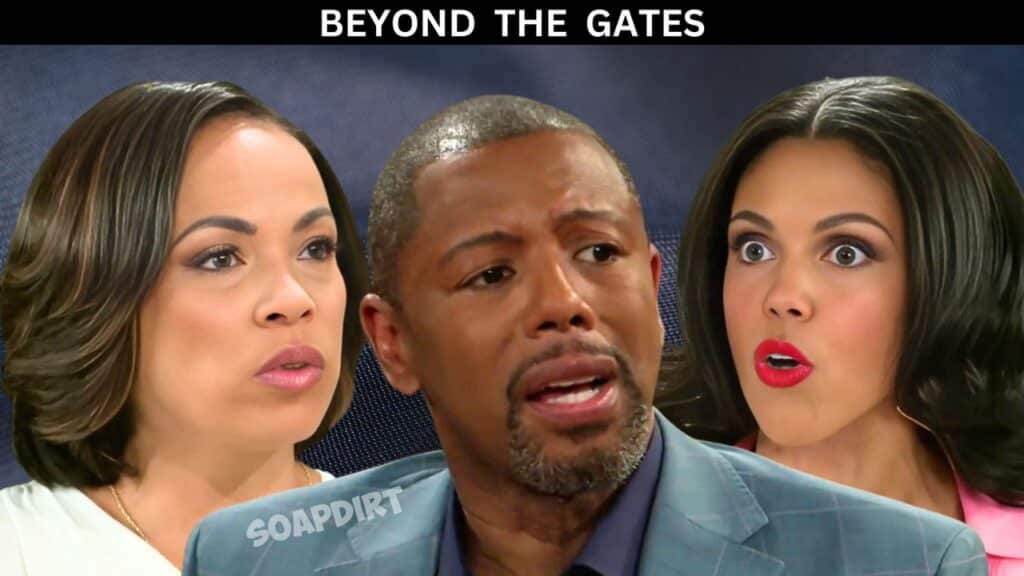
Doug’s fall: Will jealousy lead to a fatal confrontation with Joey?
Our fifth and final prediction. Doug is in danger and jealousy may surpass his sanity. So when it comes to Joey’s gambling debt, we now see Doug crazyly jealous of Joey doing things with Vanessa McBride (Lauren Buglioli). Not only real estate deeds. Joey and Vanessa used to launder money, but they were both exploding in that casino. Joey meets his wife every time. He doesn’t even want to hide it.
He was basically rubbing it on his face. And, let us know, Vanessa and Doug’s marriage was very strange before Joey’s leather jacket was squashed into the installation. Doug is a gambling addict. I think Vanessa is a sex addict, and her desire for constant attention that she doesn’t get it from Doug. Vanessa is too busy getting weird with Randos that her husband Doug takes a serious attitude towards gambling and debt. However, I don’t think Vanessa and Doug can resolve their marriage because now Joey has become a part of it because Joey puts Doug in a lot of debt after it.
Gate beyond: Dog won’t retreat?
Let’s be a reality, Vanessa loves the dangers of creepy Joey. But Doug got saltier every day. He was basically humiliating his wife last week. Vanessa applauded and said he was the one who messed him with Joey. But I still don’t think Doug would lie down this, although Vanessa would be very willing to lie down from Joey.
So, you know, Doug’s impulse control problem is an addict, but it’s one thing to know that Vanessa bets on random guys, but it’s someone Doug often sees pulling something on them. I just doubt he might become aggressive with Joey. Doug may try to throw out the last-domain and prevent it from being the gender part of the relationship between Vanessa and Joey. I don’t think the gangsters would be that way. If Doug worked too hard on Joey, he might have a desire to die.


